
Collection Stories
By Sandi Black
We’ve all heard of Superman and know he’s not afraid of a fight. He’s fought some impressive enemies in his past – Lex Luthor, General Zod, Brainiac, Darkseid, even Batman in recent years. But few of them compare to the Moa.
But how did Superman get to fight an extinct bird from Aotearoa?
The specific story is called “The Last Moa on Earth” and was written by Cary Bates, appearing in DC Action Comics Vol.36 No.425 and published in New York in July 1973. It is filled with classic DC fight scenes and melodrama but is laden with a strong environmental message.
Superman first appeared in Action Comics #1 published on 18 April 1938 (88 years ago tomorrow – happy birthday Superman!). He was created by writer Jerry Siegel and artist Joe Shuster, and has been a popular feature in comic books, radio shows, tv series, movies, and cosplay events since.
Kal-El, aka Clark Kent, was born on Krypton in outer space but was sent to Earth where he was raised in Smallville before moving to Metropolis. Smallville and Metropolis are fictional but are set in the real America, and are designed to look familiar, like real places we could visit or live in ourselves. They invite us to put ourselves in the comic, to be the protagonist – to be the hero.
As Superman, his fights largely take place in America (it’s amazing how many villains try to take over there) but has also visited other countries when needed. These are usually generic European, African, or Asian destinations where the citizens have needed Superman’s help to defeat the bad guys. Superman swoops in, points out the wrongness of the evil-doer, sorts them out, then flies off leaving the people to live in peace.
These adventures are often thinly veiled attempts at mimicking real life dictators and atrocities. Like, in 1941 when he visits Dukalia to defeat the dictator Karl Wolff, who declared “we Dukalians are superior to any other race or nation. Proof that we are entitled to be the masters of America”. Other times he’s not so subtle in righting a wrong, like in January 1942 when he disables an obviously Nazi artillery crew by bending their canon in half.
And this is the thing about Superman and comic books – they’re not just silly stories enthused about by geeks and argued over by the characters in The Big Bang Theory. They often carry a real world and very serious message… it’s just packaged up in a pair of tights to make it interesting for kids.
Superman has gone through a few phases in his career. The Golden Age of the 1940s and 1950s saw the post-war need for superheroes and many caped crusaders adorned the pages of comic books read by people who needed a distraction from the horrors of war. Superman was by far the most popular hero of them all.
In the early years of The Golden Age, Superman himself was the only science-fiction component in the stories. He was labelled ‘the champion of the helpless and oppressed’ as he fought everyday evils – munitions factories, drink drivers, child and/or wife beaters, rigged fights, crooked businessmen, and corrupt people in power. As the years went on, his abilities grew – he went from being able to leap a quarter of a mile to being able to fly, then developed heat vision, bullet-proof skin, incredible strength, time travel, and the ability to breathe in space. His foes also grew to include giants, mad scientists, and dinosaurs, but Superman was always able to defeat them.
He got into trouble early on with his violence tendencies. In an early comic he was portrayed as not batting an eye while beating a robber to death, but this caused a huge backlash so he developed a strong moral code where he would never again take a life of an enemy but instead use his words and educate, rather than eradicate.
The Silver Age from the lates 1950s and the 1960s saw more competition. Old superheroes were revived and re-launched with their previous versions being explained away as living in a parallel dimension, setting the foundation for the Earth 1 and Earth 2 multiverse storylines. Batman had a new television series and a very successful marketing campaign that attracted the spotlight away. And rival company Marvel Comics launched new characters with more sophisticated writing and storytelling that garnered a lot of attention.
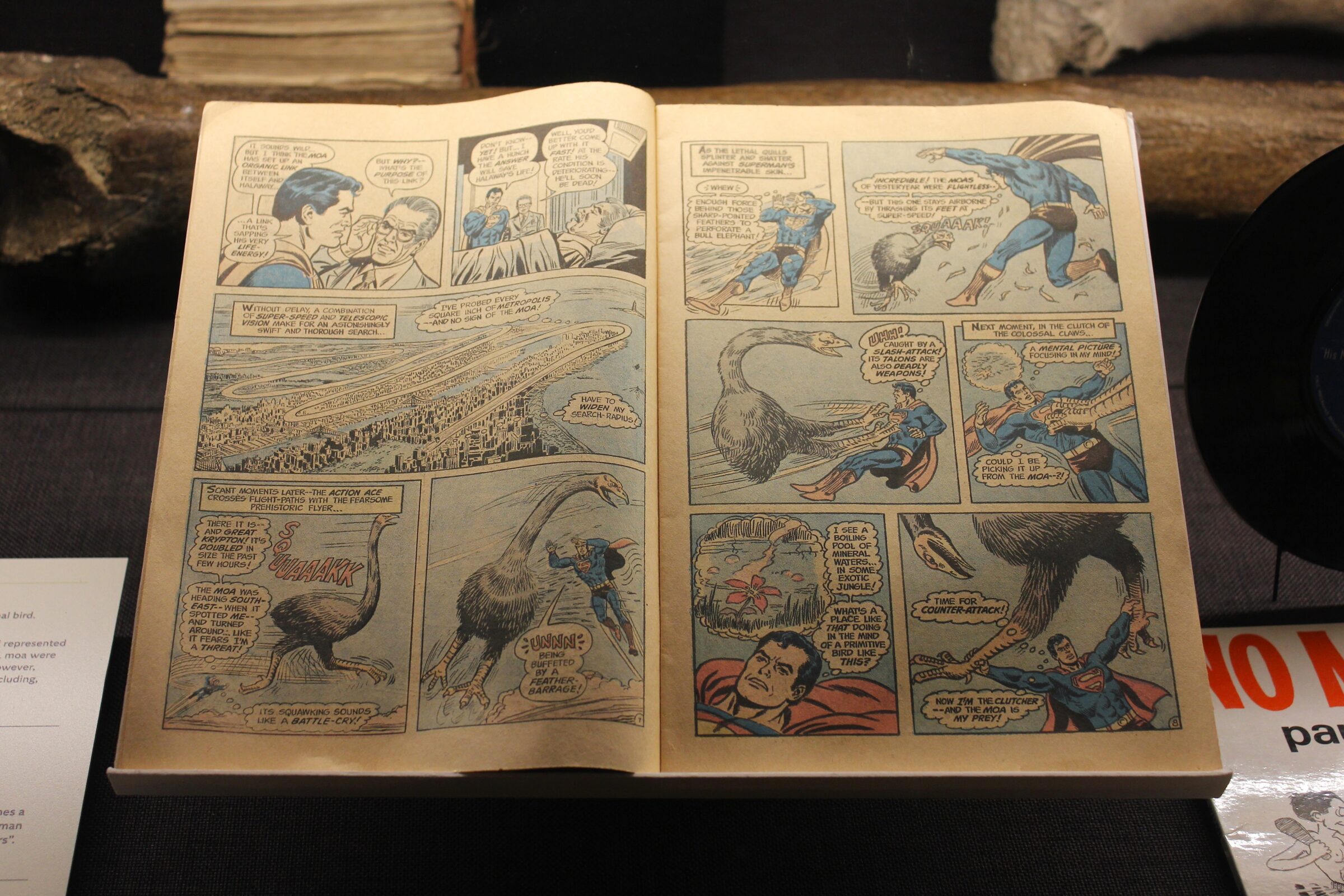
DC Action Comics Vol.36 No.425, July 1973 is on display in the Moa Gallery at Whanganui Regional Museum.
Whanganui Regional Museum Collection Ref: 2018.31
The Bronze Age spanned from 1970 to the mid-1980s and further defined the multiverses. Facing increasing competition and a worrying drop in sales, a new suite of writers decided that Superman needed some polishing to keep up with his competition. Some of his powers were scaled back, he was faced with more problems set in the real-world, and he became even more politically and socially aware; and encouraged his readers to do the same.
The 1970s was also a time when we were becoming increasingly aware of the impact our actions were having on the environment and the creatures we share it with. For a long time, some people have protested against particular trees being felled or certain patches land being damaged for resources. But the photos of the beautiful peaceful earth taken by astronauts on a trip to the moon compared to the catastrophic Santa Barbara oil spill as witnessed on the news showed a stark contrast that sparked massive social action.
A protest was begun by Wisconsin senator Gaylord Nelson and organised by volunteer students. What started as a local demonstration soon spread as the open invitation saw tens of thousands of towns and cities across America organise their own display. This was the first Earth Day held on 22 April 1970 when 20 million people took to the streets to protest environmental destruction. It was the largest coordinated protest movement at the time and made environmental issues a global concern, and Earth Day continues today being marked for the 56th time this coming Wednesday with an estimated 1 billion people worldwide taking part.
The 1970s was also an interesting time for the Moa, itself. In the 70s a collection of moa bones was unearthed near Reparoa in the Taupo area. It was believed the moa had fallen into a tomo, or steam vent, then been preserved by the ash from the Taupo Eruption in AD186.
The discovery made the news and led to a resurgence of interest in the moa.
It is also when the ‘moa browsing’ theory of plant evolution first came about. This theory hypothesizes that New Zealand’s quirky indigenous plants with their small, spaced-out leaves on wiry and interlaced branches evolved as a defense mechanism to make it harder for hungry moa to easily snack on the plants. This theory was accepted at the time, then later declared anachronistic, and is still somewhat debated. Recent experiments have leant a little weight to it, but it is also believed that climate plays an important role in plant evolution.
There was also reportedly a moa sighting near Karamea in the South Island in 1971, which would no doubt have got global imaginations firing and got people wondering if there really could be moa still hiding in the bush.
This age of early global connectivity, environmental awareness, and interest in the moa is where Superman met our bird.
In the story, hunter Jon Halaway explores the untamed jungle near Taranaki when he spooks a large bird, which aggressively defends its territory causing Halaway to panic and shoot it. Unsure what species it was, he takes it to a Research Game Reserve near Hāwera and described the encounter to the staff there – claiming the bird was around 12ft, or 3.6m tall. This is not so far fetched as the largest known specimens of moa measure around 2m tall at their back, so with their necks raised would be close to 3m.
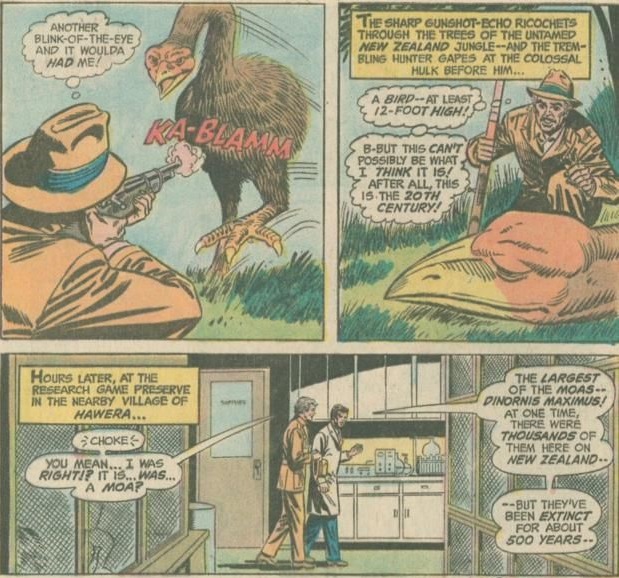
DC Action Comics Vol.36 No.425, July 1973, Whanganui Regional Museum Collection Ref: 2018.31
Back in the book, the scientist confirms the bird was a moa and is extremely surprised as they were believed extinct for 500 years. He suggests the chances of another one surviving out there is minimal that Halaway has just shot the Last Moa on Earth. Halaway is wracked with guilt and declares “What a Tragedy! With a single bullet I wiped out the last of an entire species! The Moas might even flourished again if it weren’t for me”.
In the comic, the scientist identifies the bird as a South Island Giant Moa. He doesn’t explain how it managed to get to the North Island but does give the scientific name which sounds like it could be a villain – Dinornis maximus. Technically if he was hunting in the North Island it should have been identified as the North Island Giant Moa or Dinornis novaezealandiae, but that sounds more like something out of Middle Earth. And while we’re getting technical, the name Dinornis maximus no longer invalid – it was the secondary name given to the species Dinornis robustus before we understood sexual dimorphoism, but we’re getting away from the story…
A guilt-laden Halaway is determined to right his wrongs, and remembering the scientist said the moa was a female, he returns to the jungle where he finds a very large egg. The egg was nested in an exotic marsh festooned with curious pink flowers, and he notices it was being kept warm by strange marsh gasses. He takes the egg back to Metropolis in America where he hopes to procure the help of scientists to revive the species.
Sensing a scoop, journalist Clarke Kent picks up Halaway and the egg from the airport, and during their chat in the car Halaway suddenly collapses as the egg hatches and the baby moa escapes. Kent transforms into Superman and takes Halaway to hospital where he discovers the egg had developed an ‘organic link’ with Halaway and had been sapping his energy since they left the Taranaki marsh.
Superman tracks down the fledgling, which despite only being a few hours old has already doubled in size. He soon discovers the exotic fumes have given it other extraordinary abilities – it can fly faster than a super-sonic jet by quickly thrashing its feet, attack with its feathers firing them like daggers strong enough to cut an elephant’s hide, and can even shed and regrow limbs in an instant.
During an epic mid-air battle Superman starts seeing visions of swamp with specific pink flowers and realises the Moa is telepathically sending him messages. The Moa is telling him he just wants to go back to its natural habitat, surrounded by the indigenous plant the ‘Quixa Blossom’ which was, according to the comic, only found in north-west New Zealand. A truce is agreed and Superman escorts the moa back home, and once it is surrounded by the Quixa Blossom the organic link with Halaway is broken and he starts to recover. Superman builds a fence around the exotic marsh (conveniently forgetting the moa could fly) and creates a reserve so the moa can live peacefully and without fear of further human intervention.
Superman returns to America and visits Halaway, telling him all the adventure, and the comic ends with Halaway stating: “The world owes the moa another chance for survival.”
The author of the story, Cary Bates often wrote about pollution and nuclear war and his messages cautioned his audience to be aware of their environmental impact. This story is no different. In this comic, Halaway stomps through a jungle with no idea of what he’s doing and ends up rendering a species extinct. He relies on Superman to bring it back. Superman himself could have easily killed the hostile moa with a Kryptonian glare, but instead makes sure the moa gets home to live in peace and safety.
The comic is a warning that we as a species are well aware of the damage we cause the planet and everything living on it, and yet we continue to stomp through the jungle without a second thought.
Superman isn’t real and will not swoop in to save the day, or the species. Instead, the story tries to inspire readers to be as brave and upstanding as he is, to be aware of the detriment and damage we are doing and try to follow Superman’s example and live a better, more peaceful and environmentally friendly life, to tread gently rather than stomp. He’s telling you to put your cape on, get out there, and be a hero. Just remember to wear your underwear underneath your clothes or you’ll get funny looks on the Ave.
It is too late for the moa. Scientists estimate there would have been around 160,000 of them when Polynesian settlers arrived 1200-1300CE, but that they all died out by the early 1400s.
When Europeans arrived here in the 18th and 19th centuries, they heard oral traditions of giant birds from Māori, and when large bones were unearthed some started to put two and two together. Our own Reverend Richard Taylor, a local Missionary and enthusiastic naturalist, sent bone specimens to English Biologist Richard Owen who confirmed it as a new, or rather extinct species.
Owen initially identified 13 species within the Moa family, but as science techniques and DNA Testing have improved, we now know there are nine – The North and the South Island Giant Moa, the Eastern Moa, the Stout-Legged Moa, the Little Bush Moa, Mantell’s Moa, Heavy-Footed Moa, Crested Moa, and the Upland Moa. None of these could fly, shoot feathers, or send telepathic messages, as far as we’re aware.
Or is it too late for the moa? Texas-based biotech company Colossal Biosciences announced in 2025 that they were actively working to ‘bring back the Moa’. They have partnered up with Sir Peter Jackson, the Ngai Tahu Research Centre, and Canterbury Museum and are hoping to ‘de-extinct’ the species by 2035.
Colossal are in the process of sequencing the genome of the South Island Giant Moa – the one from the comic – and plan to transfer specific traits into a surrogate bird and create a ‘hybrid’ that will physically and genetically resemble the ancient bird.
The company did a similar thing with the Dire Wolf which had been extinct for about 12,000 years. They blended ancient DNA from bone samples with current DNA from the Gray Wolf, and the first Dire Pups in thousands of years were born in 2024. They are not an exact replica, but what Colossal termed a ‘complicated chimera’.
As well as the Moa, Colossal and other such companies want to do the same with the woolly mammoth, the auroch, the dodo, and maybe even a dinosaur or two. I don’t know about that, I’ve seen Jurassic Park and think Superman had the right idea – we need to tread gently and look after things properly now.
This comic and an extensive collection of Moa bones, art and pop culture items featuring Moa are all on display upstairs in the Moa Gallery, so we’ll head up there to have a look, if there are no questions.
Sandi Black is Kaihāpai Taonga / Curator, Images and Manuscripts, at Whanganui Regional Museum.