Collection Stories
by Eruera Rerekura
A Rākau with Two Names
Te Ringa Mahi Kai is a taiaha of great significance to the people of the Whanganui River.
In Whanganui, taiaha are also commonly referred to as rākau, a word that can mean a stick, weapon or implement depending on its context. This particular rākau has carried two names during its long history.
Its earlier name was Te Waha o te Marangai, translated as The Portal of the Storm, or The Fury of the Tempest. Today it is known as Te Ringa Mahi Kai, The Cultivator’s Hand.
The story behind those names reaches back more than 200 years, to a period of conflict and considerable change in Aotearoa New Zealand. It is a story about warfare, but it is also about whenua, whakapapa and mana. At its heart is an important idea: the ability to cultivate food and care for a community should never be mistaken for weakness.
To understand how Te Ringa Mahi Kai received its name, we begin not in the upper reaches of the Whanganui River, but much closer to the present-day city.
The Battle at Purua
In 1819 or 1820, a northern taua, or war party, entered Whanganui. It included forces from Ngāpuhi and Ngāti Toa.
This was a time when muskets were changing the nature of Māori warfare. Much of the decisive fighting had previously taken place at close range, where warriors relied upon their training and skill with weapons such as taiaha, pouwhenua, tewhatewha, patu and mere. Muskets introduced the ability to inflict devastating injury from a distance.
The northern taua confronted Whanganui forces at Purua, near the foot of what is now Durie Hill.
For people familiar with modern Whanganui, the location is surprisingly ordinary. Purua Stream once flowed openly into the Whanganui River but now passes through a culvert beneath Anzac Parade. The battle took place around the area now bounded by Portal Street and Purua Street.
Whanganui forces were defeated at Purua and withdrew upriver. The northern taua followed. Purua, however, was not the end of the conflict. It marked the beginning of a journey deep into the heart of Te Awa Tupua, the Whanganui River.
The Journey Upriver
As the northern taua travelled inland, the landscape changed. The broad lower reaches of the river gave way to increasingly steep hills and narrow valleys. Streams and tributaries entered the river from many directions. The northern forces were moving further from the coast and deeper into unfamiliar country.
For Whanganui Māori, this was home. Every bend, stream, landing place, ridge and pathway formed part of a landscape known and remembered by generations of people. This knowledge was practical as well as cultural. Knowing the whenua and the river meant knowing how and where to move through it.
A well-known Whanganui whakataukī expresses the relationship between the river and its people:
Ngā manga iti, ngā manga nui e honohono kau ana hei Awa Tupua.
The great streams and the small streams flow together to form one great river.
The whakataukī describes the physical landscape, where many waterways join to form the Whanganui River. It also speaks about people. Just as many streams combine to form one river, the many hapū of Whanganui can come together for a common purpose.
The northern taua had begun its journey with the advantage provided by muskets. As it travelled further upriver, local knowledge of the landscape became increasingly important. The confrontation eventually reached Kaiwhakauka.
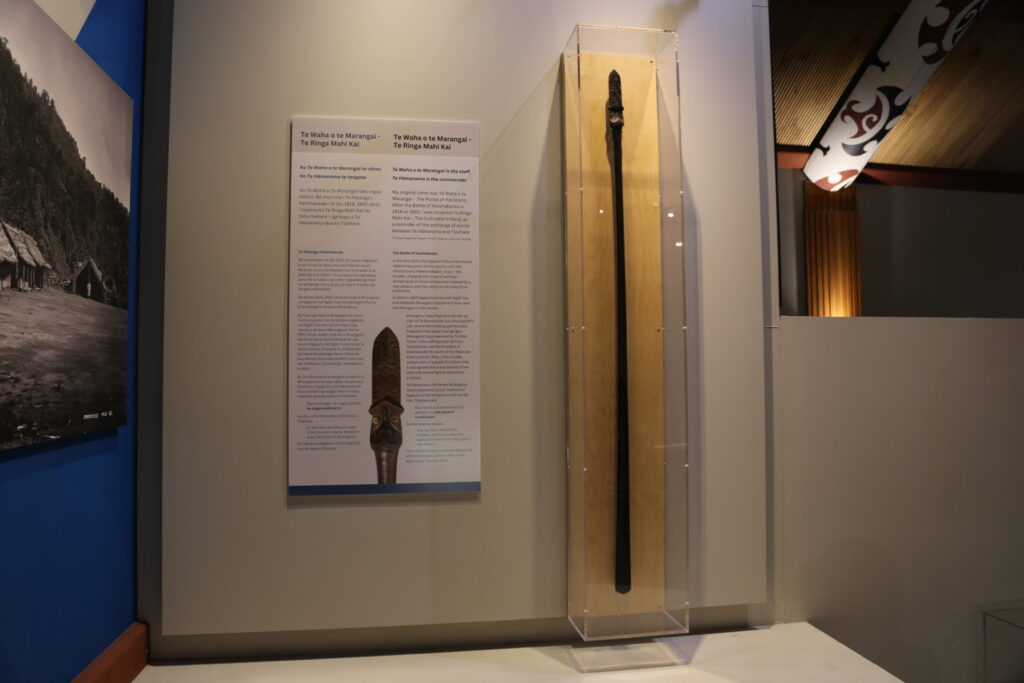
Image: Karen Hughes/Whanganui Regional Museum
Kaiwhakauka
Kaiwhakauka lies about 185 kilometres upriver from Whanganui, below the junction of the Retāruke River with Te Awa Tupua and within the rohe of Hinengākau. Today the site lies within Whanganui National Park. Kaiwhakauka Pā itself no longer stands, and people now walk and cycle through a landscape where an important chapter of Whanganui history unfolded.
At Kaiwhakauka, the northern taua encountered the combined strength of Whanganui forces led by Te Pēhi Tūroa, supported by their Ngāti Tūwharetoa relations. Musket volleys were exchanged, but neither side gained a decisive advantage. The battle reached a stalemate. According to the kōrero handed down about the battle, it was agreed that a warrior from each side would step forward. Their encounter would help determine the outcome. For the northern forces, that warrior was Tūwhare of Te Roroa and Ngāpuhi. For Whanganui, it was Te Hāmarama.
Te Hāmarama and Te Waha o te Marangai
Te Hāmarama was a celebrated Whanganui leader and an accomplished exponent of customary Māori weaponry. He is closely associated with Ōtoko Pā and is remembered by Ngāti Hineotera and Te Awaiti. His whakapapa and legacy continue through many descendants and communities of the Whanganui River.
I am one of his many descendants. My connection is through my father’s line, through Hariata Te Kaioroto and her mother, Maataroirangi Te Waenga, a daughter of Te Hāmarama and his wife Ramari. That whakapapa provides a personal connection to this taonga, but Te Ringa Mahi Kai belongs to a much wider story. Its significance extends beyond one descendant, whānau, hapū or marae. Through the events at Kaiwhakauka, it carries a history of importance to Whanganui nui tonu.
At the time of the battle, Te Hāmarama’s rākau was known as Te Waha o te Marangai. A saying remembers the relationship between the man and the rākau:
Ko Te Waha o te Marangai te rākau.
Ko Te Hāmarama te tangata.
Te Waha o te Marangai is the rākau.
Te Hāmarama is the person.
The words convey more than ownership. They connect the rākau with the person who carried it and whose story it continues to hold.
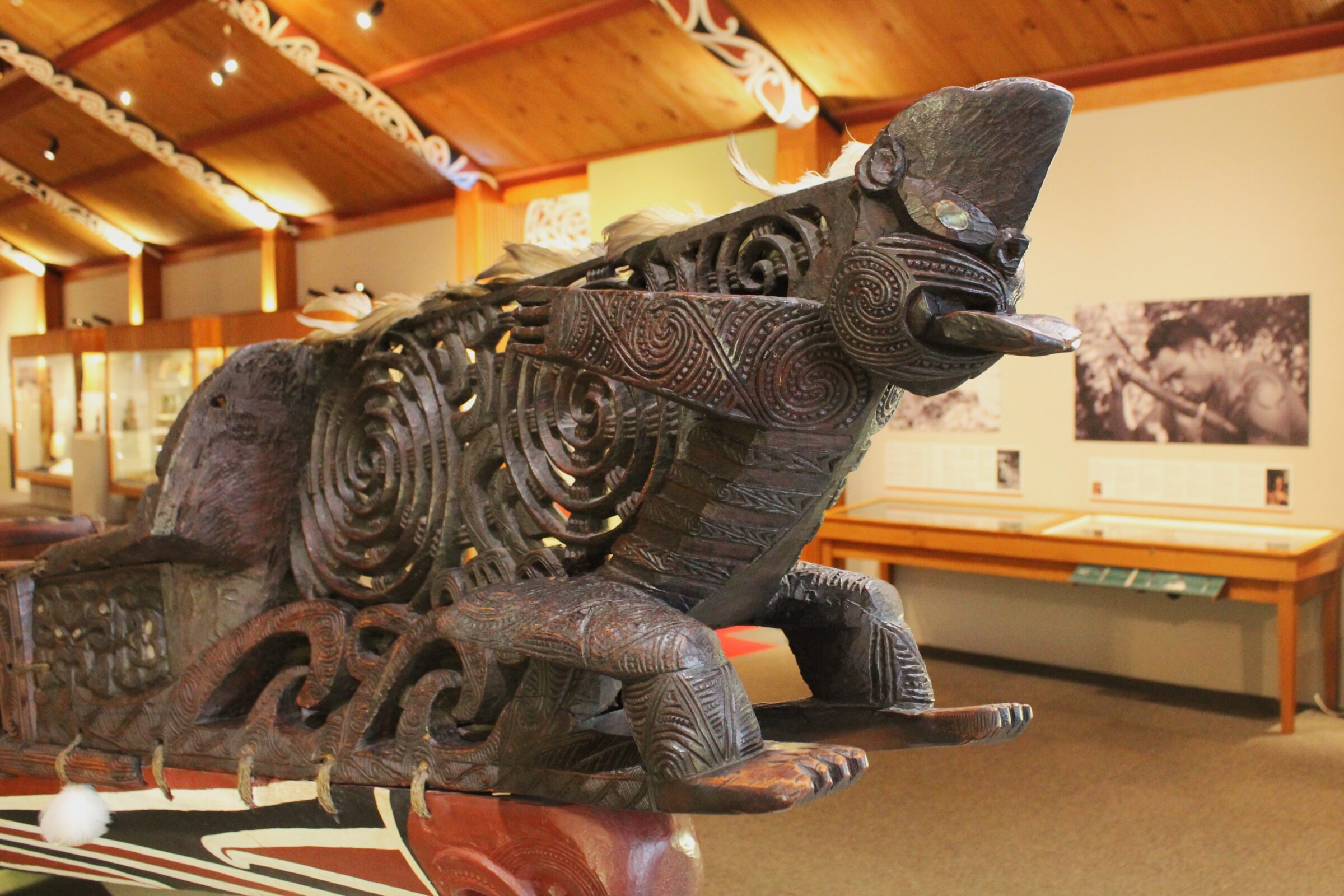
Museum of New Zealand Te Papa Tongarewa records Te Hāmarama as the maker of the taiaha and dates it to around 1810. If that attribution is correct, the hand that wielded Te Waha o te Marangai may also have been the hand that carved it. The rākau is made from native hardwood and measures about 1.7 metres in length. At one end is a carved upoko, or head, with a face on either side and eyes inset with pāua shell. From the upoko extends the arero, or tongue. The long shaft forms the tinana, or body, while the opposite end forms the rau, the smooth, flattened blade used to strike. It is an elegant object, but it was not made simply to be admired. It was a functional rākau designed for movement in the hands of a skilled exponent.
At Kaiwhakauka, Te Waha o te Marangai was in the hands of Te Hāmarama.
The Challenge
The kōrero tells us that Te Hāmarama struck Tūwhare in the temple with Te Waha o te Marangai. The blow was severe, but Te Hāmarama did not kill him there.
Tūwhare responded with an insult:
Ehara tō ringa i te ringa o te toa, he ringa mahi kai kē.
Your hand is not the hand of a warrior. It is the hand of a cultivator.
The words reflected a view of Whanganui people encountered by the northern taua. They had seen extensive māra kai, cultivated gardens, and communities able to produce plentiful food. The qualities of cultivators and food providers were interpreted as signs that Whanganui people were less warlike. At Kaiwhakauka, that assumption was challenged.
Te Hāmarama replied:
Ko koe taku ika kīhai au i patu.
E kau ki waho moana, kawea te kupu, he mana tō Whanganui.
You are my fish, whom I did not kill.
Swim out to sea. Carry the message. Whanganui has mana.
Rather than killing Tūwhare at Kaiwhakauka, Te Hāmarama sent him away carrying a message. The northern taua conceded defeat and withdrew from Te Awa Tupua. Tūwhare died from his wound three days later, inland from Waitōtara.
The Cultivator’s Hand
Following the battle, Te Waha o te Marangai became known by a new name:
Te Ringa Mahi Kai.
The Cultivator’s Hand.
A name that began as an insult was transformed into something quite different. The name remembers that the people who cultivated the whenua were also capable of defending it. Growing food, gathering kai, feeding whānau and sustaining communities were not qualities opposed to strength.
The cultivator and the warrior were not necessarily different people.
The same hand could plant.
The same hand could harvest.
The same hand could feed a child.
The same hand could hold a rākau.
The same hand could defend the community.
In this way, Te Ringa Mahi Kai became more than a new name for an old weapon. It carried forward a statement about the people of Whanganui and the strength of communities grounded in their whenua.
The Handley Purchase
The history of Te Ringa Mahi Kai after Kaiwhakauka is less complete. We do not yet know every detail of how the rākau passed from its earlier Whanganui custodians into the hands of collector John Handley. That gap is important to acknowledge. Museum records can tell us much about the movement of taonga once they entered collecting systems, while sometimes recording much less about the circumstances in which they left the communities to whom they belonged.
What is known is that in 1905 Te Ringa Mahi Kai became part of what is now called the Handley Purchase, a collection of approximately 259 taonga acquired by Handley from across the Whanganui and Taranaki regions.
At the time, the collection was held on deposit at the Whanganui Museum. Augustus Hamilton recommended that the New Zealand Government purchase it. His intention was that the Colonial Museum in Wellington would retain the objects it required, with the remainder being presented to the Whanganui Museum. The collection was sent to Wellington for cataloguing, and Cabinet approved its purchase from Handley for £550 in July 1905. On an early specimen schedule, the taiaha was recorded as coming from the Whanganui district and having been collected by Handley and purchased from him in Whanganui. It was assigned accession number 19/1.
Today, Te Ringa Mahi Kai forms part of the collection of the Museum of New Zealand Te Papa Tongarewa, where its registration number is ME001246.
In 2019, the rākau returned to Whanganui on loan from Te Papa, enabling uri and the wider community to reconnect with this ancestral taonga in the place from which its story comes.
Why Te Ringa Mahi Kai Matters
Te Ringa Mahi Kai is more than an old weapon. It is more than carved wood and pāua shell, and more than an object identified by a museum registration number. It is a taonga that carries relationships between people and place, tūpuna and descendants, the river and its communities, and the past and present.
For descendants of Te Hāmarama, including my own whānau, those relationships are expressed through whakapapa. For Ngāti Hineotera and Te Awaiti at Ōtoko, the rākau is connected with an important tūpuna. Its story also reaches more widely across the hapū of Te Awa Tupua and Whanganui nui tonu. But a person does not need to whakapapa to Te Hāmarama, or even to be Māori, to find meaning in its story. Providing for others, nurturing a community, knowing the place you call home and protecting what matters are experiences that can be understood across cultures. Te Ringa Mahi Kai reminds us that strength is not measured only by the ability to fight.
Strength can also be found in growing food.
In caring for whānau.
In knowing the land.
In sustaining a community.
And in people standing together.
Kaiwhakauka Pā no longer stands. Its palisades and buildings have disappeared, and the people who fought there lived more than two centuries ago.
Te Ringa Mahi Kai remains.
Through the rākau, the memory of that encounter has survived, together with a message attributed to Te Hāmarama that continues to resonate in Whanganui:
Kawea te kupu. He mana tō Whanganui.
Carry the message. Whanganui has mana.
Te Ringa Mahi Kai at Whanganui Regional Museum
In 2026, Te Ringa Mahi Kai was displayed at Whanganui Regional Museum inside a secure exhibition case positioned above a plinth overlooking the Māori Court. The elevated position allows visitors to look up towards the rākau as it looks out across the taonga within the gallery. Beside it is an enlarged historical photograph of Kaiwhakauka Pā. Together, the two provide different connections with the same history: the landscape where the events took place, and the rākau that continues to carry their memory. For a taonga whose story has travelled for more than 200 years, their presence together provides an opportunity to encounter the history of Kaiwhakauka not simply as an event from the past, but as a living relationship between taonga, whenua, whakapapa and the people of Te Awa Tupua.
Eruera Rerekura is Kaihapai Taonga Maori/Curator, Taonga Maori at Te Puni Tiaki Taonga o Whanganui/Whanganui Regional Museum
Main image: Te Rangi Mahi Kai
Photographed by Kathy Greensides