
Collection Stories
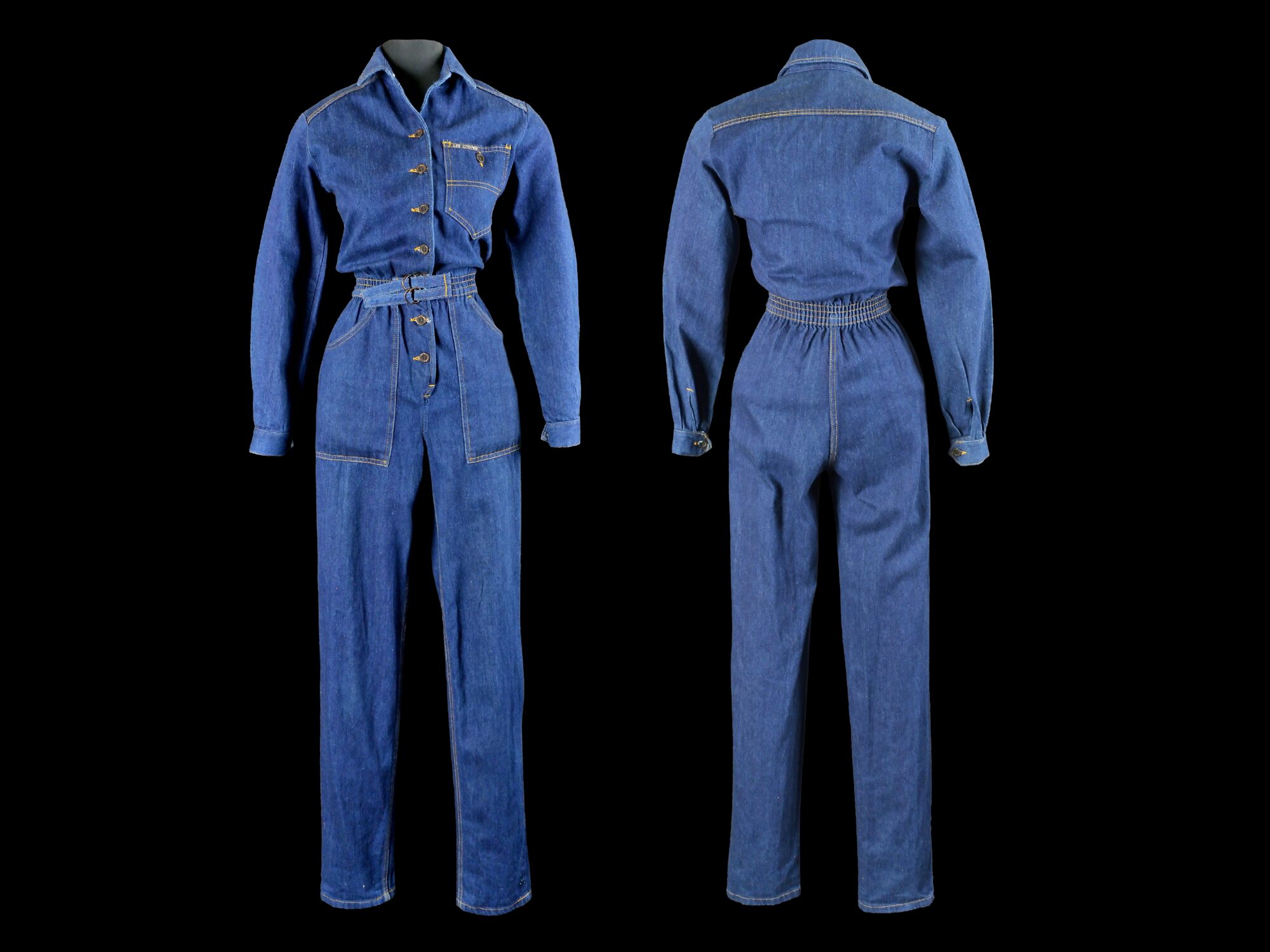
This utilitarian, late-1970s Lee Cooper jumpsuit features yellow contrast stitching, oversized patch pockets and fitted waist with double D-ring belt.
Made of denim, a cotton twill fabric woven with indigo-dyed vertical warp threads and undyed white horizontal weft threads, it has a distinct diagonal ribbing with dark blue fabric face and paler fabric back.
While denim, and particularly jeans, are a familiar fashion staple today, their origins date back to 17th-century Genoa, Italy when weavers produced heavy-duty, indigo-dyed cotton and wool fabric which was favoured by sailors and the working class. Weavers in Nîmes, France tried to replicate the fabric, creating “serge de Nîmes,” (twill of Nîmes) or “denim.”
In 1873 Levi Strauss and Jacob Davis patented riveted denim pants for American miners and by 1934 “Lady Levi’s”, the first women’s jeans were introduced.
By the mid-1950s jeans had transcended workwear to become fashionable and by the late-20th century were a symbol of rebellion, political protest, identity and self-expression, adopted by American civil rights campaigners, punks and hip-hop culture.
Denim jean’s evolution is unique: no other piece of clothing has had such an enduring, global impact or carried such cultural significance.
Jumpsuit, 1976 – 1980
Designer and maker Lee Cooper (established 1908), England
Made from cotton denim, metal buttons and belt fastenings
Purchased from SaveMart Whanganui, 2003
WRM 2003.71.7
Photographed by Kathy Greensides
View the full-length image