
Collection Stories
by Maeve Egan
In 2025, Whanganui Regional Museum was honoured to receive a remarkable addition to its collection: a 3 ½ inch refractor telescope, hand-made around 1900 by pioneering New Zealand amateur astronomer Joseph Thomas Ward. Generously gifted by Ward’s grandson, Ash Ward, this instrument represents far more than an early telescope—it is a tangible connection to one of New Zealand’s most influential amateur scientists.
Born in Chelsea, London, in 1862, Joseph Ward was an intelligent and widely read young man who was initially educated for the Catholic priesthood. However, he chose a very different path and went to sea. After working as a sailor, he immigrated to New Zealand around 1880, spending time as a shepherd and shearer in Marlborough before working as a saddler in Wellington.
By 1896, Ward had settled in Whanganui with his wife, Ada Evelyn Wright. He established a lending library, later expanding into a bookshop and stationery business, and also taught violin. Yet astronomy remained his greatest passion.
Around 1899, Ward acquired a 4½-inch refracting telescope. When a bright comet appeared in 1901, local residents queued for the opportunity to look through it. This moment captures something essential about Ward’s character: he believed astronomy should be shared. Throughout his life, he worked tirelessly to make the wonders of the night sky accessible to others.
Ward was also one of New Zealand’s earliest and most accomplished telescope makers. At a time when scientific instruments were expensive imported luxuries, he taught himself the demanding craft of optical engineering. Using hand-ground glass, mathematical precision, and extraordinary patience, he produced numerous telescope mirrors ranging from 6 to 14 inches in diameter. These mirrors found homes in observatories throughout New Zealand, where many remained in use for decades.
His greatest achievement came in 1924 when he completed a reflecting telescope with a 20.5-inch mirror, the largest telescope ever built by a New Zealand amateur astronomer at the time. The record stood for more than forty years. Such was Ward’s influence that Wellington astronomer Algernon Charles Gifford later suggested that most reflecting telescopes in New Zealand could trace their origins, directly or indirectly, back to his work.
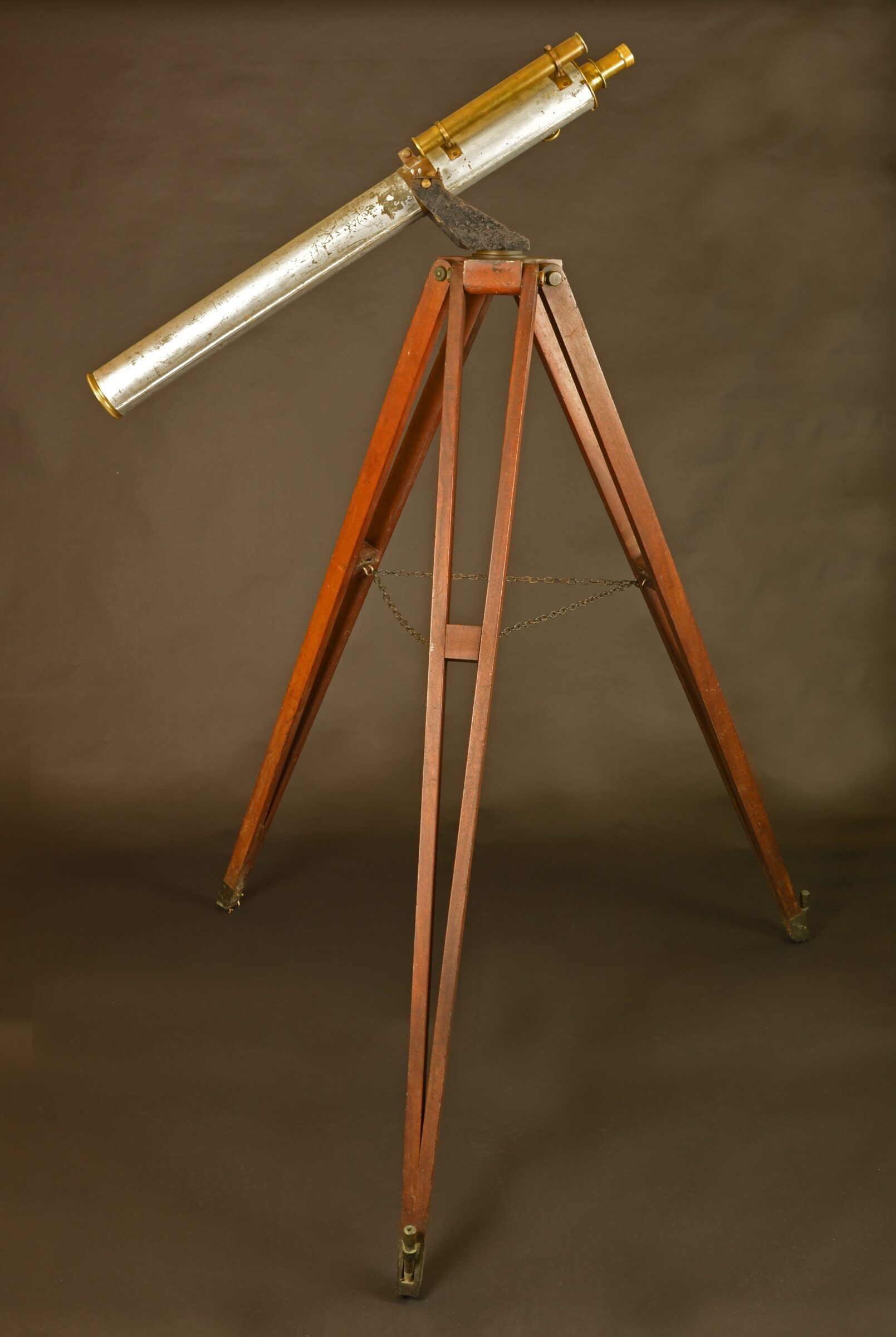
The telescope recently donated to the museum is one of Ward’s earlier creations, built around 1900. At first glance, it appears surprisingly modest. The telescope tube is thought to have been made from a drainpipe, reflecting Ward’s ability to improvise with available materials. The tube was painted silver by Ash Ward in the mid-1960s, and although the paint has since deteriorated, the instrument remains a fascinating example of practical ingenuity.
The telescope features three interchangeable brass eyepieces, likely made by Ward himself, along with a carefully designed wooden tripod. Adjustable legs, secured by a central chain, provide stability, while a simple but effective mounting system allows the telescope to be firmly secured while remaining easy to manoeuvre. Every component demonstrates Ward’s combination of craftsmanship, creativity, and technical skill.
Ward’s passion for astronomy extended well beyond telescope making. In 1901, he helped organise a series of public astronomy lectures in Whanganui. The enthusiasm generated by these events led to the formation of the Whanganui Astronomical Society, with Ward elected as its first president.
One of the society’s earliest ambitions was the construction of an observatory. Ward located a second-hand 9½-inch refracting telescope in England, recognising its potential as a public scientific instrument. The society purchased it, and it was installed in a purpose-built observatory at Cook’s Gardens. Officially opened in 1903 by Premier Richard Seddon, the observatory—today known as the Ward Observatory—remains one of New Zealand’s oldest public observatories.
As honorary director, Ward transformed the observatory into a centre for both research and public education. Working with his assistant Thomas Allison, he spent years surveying the southern sky for double stars. Together they catalogued more than 200 pairs, with 88 still officially recognised today as “Ward doubles.” His observations of sunspots, Mars, and comets also gained international attention.
Despite these achievements, Ward published relatively little. His legacy rests not on academic papers but on observation, craftsmanship, and education. For more than two decades, he delivered public lectures, hosted regular observing nights, and wrote an astronomy column for the Wanganui Herald. He believed that scientific knowledge belonged to everyone.
Joseph Ward died in 1927 at the age of 64. Following his death, Sir Robert Stout described him as a man of exceptional intellect and reasoning ability. His son, William Herschel Ward, continued his work at the observatory for more than thirty years, while his grandson Ash Ward has helped ensure that his story remains alive today.
From sailor and shepherd to internationally respected astronomer, Joseph Ward’s life demonstrates that scientific achievement is not confined to universities or research institutions. Through dedication, curiosity, and skill, he helped build New Zealand’s astronomical capability from the ground up.
Today, while the whereabouts of many of Ward’s telescopes remain unknown, we are fortunate to preserve this early example in our collection. It stands as a testament to a remarkable individual whose passion for astronomy continues to inspire more than a century later.
Maeve Egan is Kaihāpai Taonga/Curator, Social and Natural History at Te Puni Tiaki Toanga o Whanganui/Whanganui Regional Museum
Telescope and tripod, circa 1900
Made by Joseph Ward
Made from wood, metal, brass, and glass
Donated by Ash Ward, 2025
WRM 2025.17.1
Photographed by Kathy Greensides
View the full image