Collection Stories
by Eruera Rerekura
Standing in the Māori Court of Te Puni Tiaki Taonga o Whanganui | Whanganui Regional Museum, Te Mata o Hoturoa commands immediate attention. At 21.8 metres (71.5 feet) in length, it is one of the largest surviving waka associated with the Whanganui River and remains one of the museum’s most significant taonga.
Yet Te Mata o Hoturoa is much more than an impressive vessel. It is a witness to nearly two centuries of Whanganui history. Its story stretches from the forests of the upper river to the conflicts of the nineteenth century, through the care of the Hīpango whānau, and ultimately into the museum, where it continues to inspire new generations.
The story of Te Mata o Hoturoa is, in many ways, the story of the Whanganui River itself.
Origins on the Upper River
According to tribal tradition, the tōtara used to create the hull of Te Mata o Hoturoa was felled at Ngārara-huarau, near Kākahi on the upper Whanganui River, just south of Taumarunui. The tree is believed to have been cut around two hundred years ago, placing its origins in a period when the river remained the principal highway connecting communities throughout the region.
The location itself is significant. Kākahi lies within an area where whakapapa connections link Whanganui and Ngāti Tūwharetoa tribal communities, reflecting the kinship networks that have long connected neighbouring peoples.
Long before Te Mata o Hoturoa became a waka, it existed as a towering tōtara standing beside the awa. For Māori, selecting a tree of this scale was not simply a practical decision. The process involved knowledge, ceremony, and an understanding that the tree itself possessed mauri and significance.
The waka was carved by Te Tarapounamu, remembered as a rangatira and master carver of the region. Constructed in a style suited to the Whanganui River, Te Mata o Hoturoa reflects generations of accumulated knowledge about river travel, engineering, and design.
Its name also hints at wider ancestral connections. Hoturoa was the captain of the Tainui waka, one of the great voyaging canoes associated with the settlement of Aotearoa. The name therefore places Te Mata o Hoturoa within a continuum that stretches from the Pacific voyages of the ancestors to the river networks of inland Whanganui.
Life on the Awa
For centuries, the Whanganui River served as the region’s principal transport corridor. Long before roads and railways, communities depended on waka to maintain relationships, transport people and goods, and travel throughout the river system.
Museum records describe Te Mata o Hoturoa as being capable of carrying between sixty and seventy warriors. A vessel of this scale was not simply a means of transport. It represented the collective effort, resources, and expertise of the community that built and maintained it. The waka was an expression of mana as much as it was a practical vessel.
On the Whanganui River, waka connected people to one another and to the landscape itself. They carried travellers, food, trade goods, stories, and whakapapa. In many respects, they were the lifeblood of the river.
Like many important taonga, Te Mata o Hoturoa adapted to changing circumstances. During the late nineteenth century, a motor was attached to assist travel on the upper reaches of the river. This serves as a reminder that taonga were not frozen in time. They continued to evolve alongside the communities that used them.
Conflict and Survival
Te Mata o Hoturoa also bears witness to one of the most turbulent periods in New Zealand history.
Historical accounts held by the museum associate the waka with the great Whanganui expedition against Te Rauparaha’s stronghold at Kāpiti Island during the 1820s. Some accounts suggest that as many as two thousand warriors from different tribal groups participated in the campaign.
The scale of such an expedition is difficult to comprehend today. Hundreds of waka and thousands of people moving together would have represented an extraordinary feat of coordination and organisation.
The waka later participated in conflicts closer to home. Early museum records specifically note its involvement in engagements at Pipiriki, Ōhautahi, and Moutoa. Physical evidence of this history remains visible today. Bullet holes and embedded projectiles within the hull have long been associated with fighting at Puketapu and Ōhautahi in 1865.
These scars are among the most compelling aspects of the waka’s story. They remind us that Te Mata o Hoturoa was not created as an artefact for display. It was built to serve the people of the river and took part directly in events that shaped the history of Whanganui.
The Hīpango Whānau and the Preservation of a Taonga
The survival of Te Mata o Hoturoa into the twenty-first century owes much to the kaitiakitanga of the Hīpango whānau of Pūtiki.
The museum’s 1917 Annual Report records the presentation of the waka by Mrs Hīpango and Mrs Scott, describing it as a canoe of special significance to the people of the Whanganui district. Later records suggest that the waka remained on deposit before eventually becoming a permanent gift, with a handwritten note added in 1930 simply stating: “Now given to the Museum.”
The principal donor was Ema Hīpango (Huakahi), a respected kuia of the Whanganui River and a life member of the museum. An obituary published in the Auckland Star in 1937 highlighted her connections to several Whanganui River hapū and noted the esteem in which she was held by both Māori and Pākehā communities. The museum trustees were represented at her tangihanga following her death in 1934.
Ema’s husband, Waata Wiremu Hīpango, was the son of Hōani Wiremu Hīpango, one of the most prominent Whanganui leaders of the nineteenth century. Hōani Hīpango was among the first Whanganui Māori to embrace Christianity and accompanied Reverend Richard Taylor to England in 1855, where he was granted an audience with Queen Victoria and presented gifts from Whanganui tribes.
The Hīpango family’s contribution to preserving waka heritage extended beyond Te Mata o Hoturoa. Ema and Waata were also responsible for gifting the celebrated waka taua Teremoe to the Dominion Museum, now Te Papa Tongarewa.
Together, Te Mata o Hoturoa and Teremoe represent two of the most significant surviving waka associated with Whanganui. The fact that both survive today is due in no small part to the foresight and generosity of the same whānau.
Importantly, the relationship between the Hīpango whānau and Te Mata o Hoturoa did not end when the waka entered the museum’s collection. The whānau’s role as kaitiaki has continued through successive generations. Today, that responsibility is held by Harete Hīpango, reflecting an enduring connection between the waka and the descendants of those who cared for it during its lifetime on the Whanganui River.
Reconstruction and Museum Life
When Te Mata o Hoturoa entered the museum’s collection, it was essentially a large tōtara hull.
Museum diaries from 1930 provide an insight into the reconstruction work that followed. The carver Wiremu Te Tauri, of Te Āti Haunui-a-Pāpārangi and Ngāti Tūwharetoa descent, was engaged to undertake restoration work. Diary entries record him carving the taurapa, working on the canoe headpiece, and organising additional assistance.
One entry notes that Te Tauri arranged for two Pākehā craftsmen, Mr Downes and R. Christie, to assist with the carving. Their involvement provides an early example of Māori and Pākehā working together in the preservation of an important taonga.
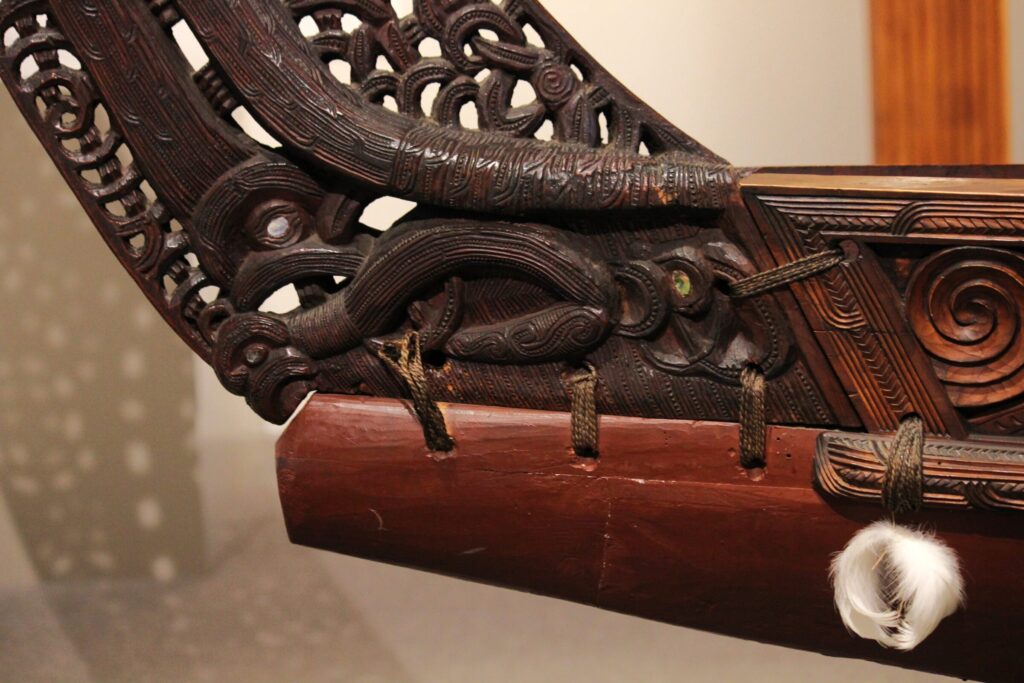
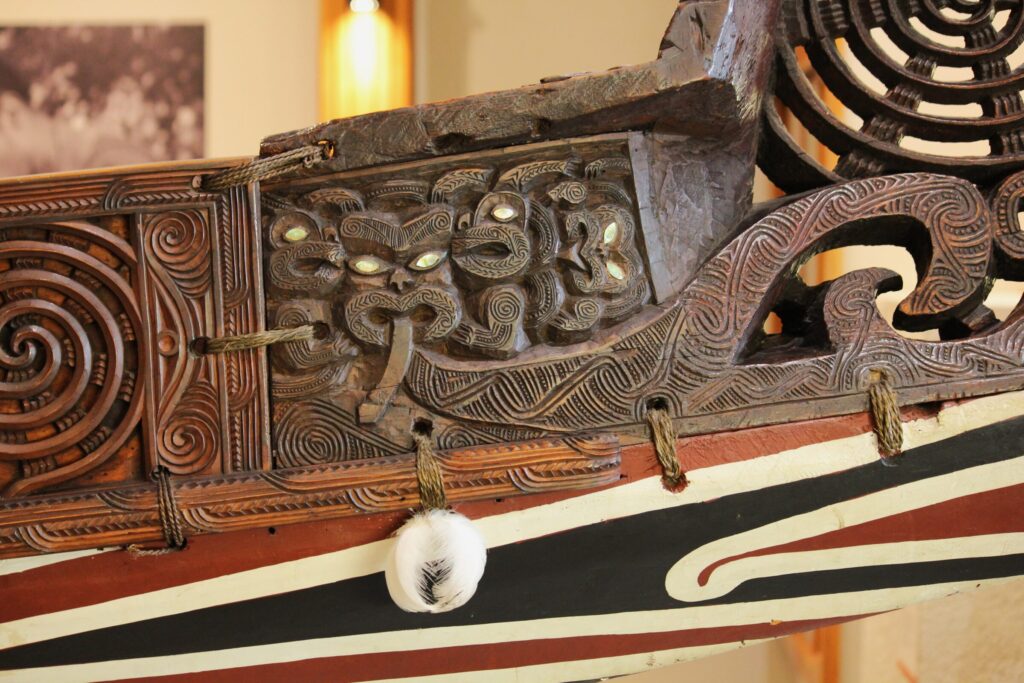
The striking tauihu and taurapa visible today were added during the reconstruction work of the 1930s. They came from the collections of the former Dominion Museum in Wellington.
Significantly, they were selected by Ema Hīpango herself during discussions associated with the transfer of Teremoe to the national museum. Through those decisions, Ema continued to shape the future appearance of Te Mata o Hoturoa long after gifting it to Whanganui.
Later diary entries record the arrival of timber for the rauawa, or upper side boards, completing the reconstruction process.
The Te Mata o Hoturoa that visitors encounter today is therefore the result of many hands and many generations. Carvers, donors, museum staff, researchers, whānau, and community members have all contributed to its preservation.
By the middle of the twentieth century, Te Mata o Hoturoa had become one of the museum’s most important taonga. Its significance was recognised in 1968 when the Māori Court extension was designed specifically to accommodate the waka. Rather than fitting the waka into an existing gallery, the gallery itself was built around the waka.
At nearly 22 metres in length, that decision was no small undertaking. More than half a century later, Te Mata o Hoturoa remains the centrepiece of the Māori Court and one of the defining taonga of the museum.
Continuing the Journey
Te Mata o Hoturoa is not the only great waka taua connected to the history of Whanganui. Also in the care of the museum is Te Wehi o te Rangi, another significant waka taua associated with the Battle of Moutoa in 1864. While Te Mata o Hoturoa carried warriors into conflicts along the river, Te Wehi o te Rangi reminds us that the story of Whanganui’s chiefly waka is much larger than any single vessel.
Beyond the museum, Teremoe remains another important part of that story, linking the histories of these great waka through the Whanganui River, the people who travelled in them, and the whānau whose foresight helped ensure their survival.
One can only imagine what it would be like to see Te Mata o Hoturoa, Teremoe, and Te Wehi o te Rangi gathered beneath one roof once again.
That, perhaps, is a story for another time.
For now, Te Mata o Hoturoa remains one of the most powerful reminders of the relationship between the people of Whanganui and their river. Every visitor who stands before it, every researcher who uncovers another piece of its history, and every young person inspired by the stories it carries becomes part of the next chapter in the life of this taonga.
Like the river itself, its story continues to flow, carried forward by the people who continue to care for it.
Eruera Rerekura is Kaihapai Taonga Maori/Curator, Taonga Maori at Te Puni Tiaki Toanga o Whanganui/Whanganui Regional Museum
Image: Te Mata o Hoturoa at Whanganui Regional Museum