Collection Stories
by Eruera Rerekura
In 2023, Te Koanga o Rehua returned to Whanganui.
I remember the dawn ceremony clearly. The atrium of the Whanganui Regional Museum was packed — one of the biggest occasions I have seen in that space. Whānau, kaumātua, community members, museum staff — shoulder to shoulder — gathered to welcome her home.
There was a weight to that morning. Not just ceremony. Not just protocol. But recognition. Recognition that something significant was returning to the river, and to its people.
My name is Eruera Rerekura. I descend from Ngāti Tuhoro of Te Pōti Marae — where Te Koanga o Rehua once stood — and from Ngāti Kurawhatia of Pīpīriki, just across the river. So, this taonga is not simply something I research or curate in my role as Curator Taonga Māori at the Whanganui Regional Museum. It connects directly to my own whakapapa.
I grew up in Whanganui, left as a young adult and spent more than three decades working in broadcasting as a journalist. In 2020, I returned home and worked at Awa FM, reporting for our regional Māori news service, now known as Taiuru News. In October 2024, I stepped into my current role at the museum. In many ways, I haven’t left storytelling behind. I’ve simply shifted the medium.
And Te Koanga o Rehua carries one of the most layered stories in our region.
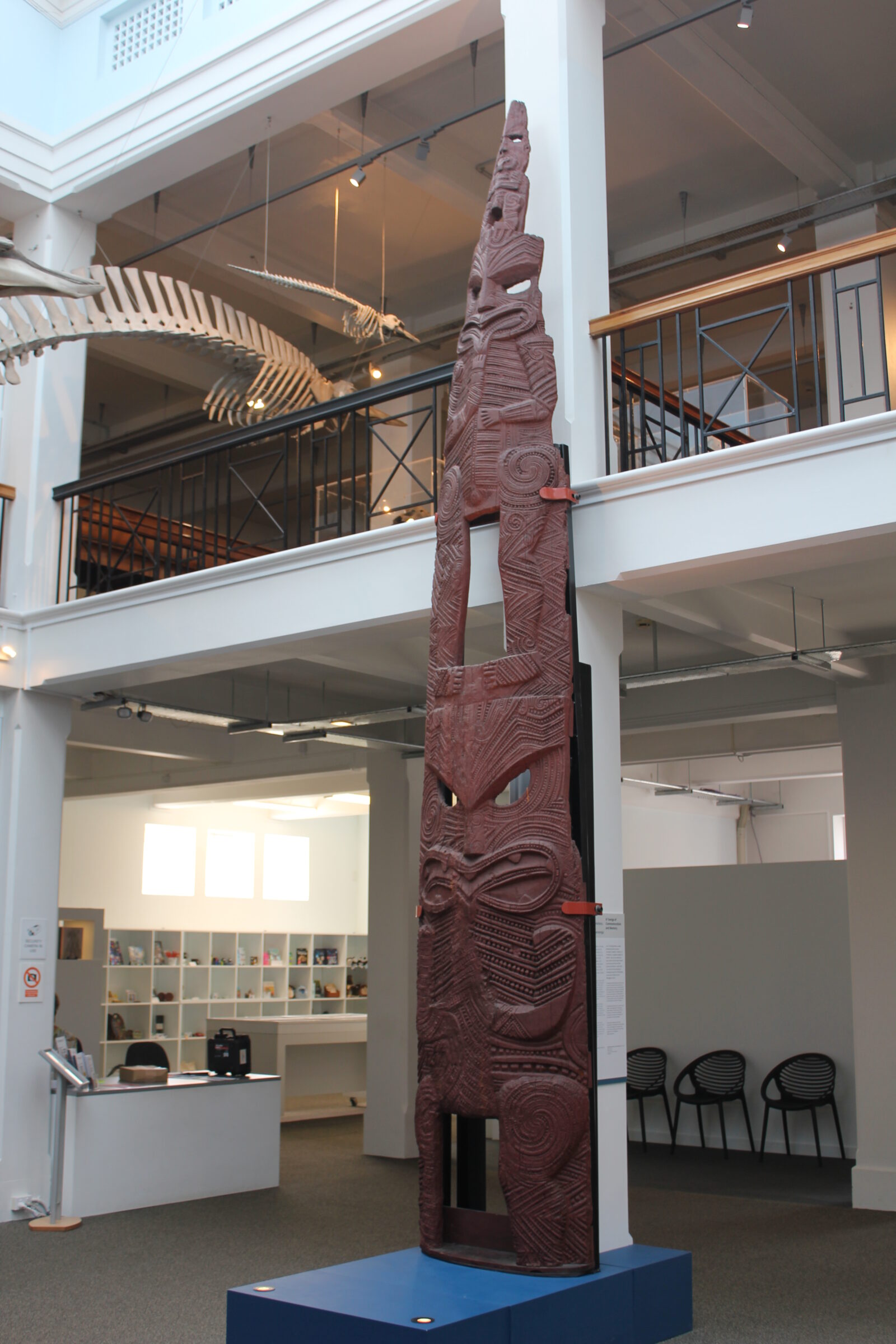
She began her life as a waka taua — a war canoe that once travelled the currents of Te Awa Tupua, the Whanganui River. Later, she was transformed into a waka whakamaumahara, a canoe of remembrance.
She was carved to depict three tūpuna. The carving was shaped using only stone tools: toki kōhatu, stone carving blades; toki pākohe, cutting tools made from argillite; and toki pounamu, greenstone shaping implements. No steel. No modern chisels. Every contour formed through patience and repetition. The work stands as a testament to the skill, endurance and craftsmanship of our tūpuna.
Te Koanga o Rehua was created in memory of Te Mahutu, a rangatira of Pīpīriki. His whakapapa also connects to Ngāti Maru of inland Taranaki, whose rohe borders the middle reaches of the Whanganui River. These interwoven ties remind us that the river has never existed in isolation. Te Mahutu’s descendants are still living today, some in New Plymouth, carrying those connections forward.
Following the Battle of Moutoa in 1864 — a conflict that divided iwi and reshaped relationships in Whanganui — the waka was moved from Pīpīriki down river to Pūtiki near the river mouth. She later stood in a local urupā (cemetery). Over time, decay took its toll and she collapsed.
Her story then intersected with that of Te Keepa Te Rangihiwinui, also known as Major Kemp — the son of Rere o Maki, one of the few wāhine signatories of Te Tiriti o Waitangi when it reached Whanganui. Te Keepa retrieved the remains and took them south to Horowhenua, the homeland of his Muaūpoko father. He later presented them to Sir Walter Buller — a naturalist, collector, barrister, and a man deeply involved in Native Land Court proceedings — who had acted as counsel for Te Keepa.
At that time, the waka was rededicated to Te Riunga, a female ancestor of Te Keepa. By 1911, Te Koanga o Rehua had entered the collection of the Dominion Museum, now the Museum of New Zealand Te Papa Tongarewa.
And there she remained. For decades. In storage. Out of the river’s sight. Out of Whanganui hands.
This is the point in the story where many taonga left their rohe — through gifting, through pressure, through legal processes, through relationships of power that were rarely equal. It is a familiar pattern in Aotearoa’s history. But this story did not end there.
Over many years, Whanganui kaumātua engaged in quiet, steady conversations with Te Papa. Not confrontational. Not rushed. Grounded in whakapapa and responsibility. The kaupapa was not simply ownership. It was connection — recognising that this taonga belongs spiritually and genealogically to this river and its people.
In 2023, after decades of kōrero, Te Koanga o Rehua returned to Whanganui on long-term loan, into the care of Whanganui Regional Museum Trust. There, she was installed as a permanent display at the heart of the Museum’s entrance, for all to appreciate and experience anew. To install her into the Museum atrium required a crane — steel cables, engineers, careful positioning. It was no small task. But the physical lifting was only part of the story. The greater work was the rebuilding of relationships.
For whānau from Pīpīriki and Te Pōti, that return carries particular weight. It is a visible reminder of tūpuna whose stories continue to shape us. But her presence in the museum also belongs to the wider community.
Some have asked who the three carved faces represent. Interpretations vary. What is undeniable is this: they represent continuity. No matter where a taonga travels, the ancestors remain embedded within it.
Te Koanga o Rehua also shares her name with the wharepuni (meeting house) at Te Pōti Marae across the river from Pīpīriki. That shared name is not coincidence. It is memory layered upon memory.
Today she stands in the Whanganui Regional Museum not as a relic, but as a living thread in an ongoing story.
For Whanganui River uri — and for the wider community, whether from Te Kaihau a Kupe Castlecliff, Aramoho, St John’s Hill, Mangamahu or beyond — her presence invites reflection.
What does it mean for something to come home?
What responsibilities come with that return?
Te Koanga o Rehua once moved with the current of the river.
Now she stands, asking us to move.
Eruera Rerekura is Kaihapai Taonga Maori/Curator, Taonga Maori at Te Puni Tiaki Toanga o Whanganui/Whanganui Regional Museum
Waka Whakamaumahara – Canoe Cenotaph, date unknown
Makers unknown
Made from wood
On loan from Te Papa Tongarewa
ME003199
View a full-length image